Offerings · High Integrity Selling System · Sales Training and GTM Transformation
Your best sellers are not selling harder. They are running a different conversation.
I train your sellers and managers in one buyer conversation, then coach it on live deals until your managers are running it without me.
The longer version of thatClose
One buyer conversation your whole team can run, taught in a room, coached on live deals with your managers on the calls, and held in place until it is simply how your people sell.
What gets installed
BUILT TO SCALE COMPELLING CONSISTENT CONVERSATIONS
High Integrity Selling.
A go-to-market system for negotiating value
I help organizations nail and scale the story, powering profitable predictable growth.
- ALIGNTHE ORGANIZATION
- One compelling message that executes the strategy, aligned across every function.
- ENERGIZETHE GO-TO-MARKET TEAM
- Delivered consistently in every pre-sale, post-sale, marketing and product conversation.
- This offer
- SUSTAINTHE BEHAVIORS THAT BUILD CULTURE
- Coached into habit by trained managers, and by an AI coach built on your message.
THE HIGH INTEGRITY SELLING SYSTEM · ENERGIZE THE GTM TEAM TO ACT ON THAT MESSAGE
Training is where it starts. The behavior that holds is the focus.
WHY PROGRAMS FAIL › WHAT WE DO ABOUT ITClose
- 2
It does not equip the front lines effectively.
Managers are enabled before the field, never after. The people who will coach it own it before anyone is trained.
- 5
It stops at what. It never gets to how.
We teach the how. Your message and one structure, in each seller’s own style.
WHAT MOST METHODOLOGY PROVIDE
- What to do.
- When to do it.
- Who to do it with.
WHAT IS RARELY TAUGHT WELL: THE HOW
- How to run discovery.
- How to have a compelling conversation.
- How to build the mutual success plan.
DISCOVERY, STEP BY STEP
HUMILITY
Research, form hypotheses, then ask open-ended mutual discovery questions that validate and frame. Or invalidate and qualify out.
- 1
FRAME CALL
Provide a point of view and ask the opening question.
- 2
CURRENT STATE
If the client shares many problems, have them prioritize.
- 3
IMPLICATIONS
Get deep into the current state’s revenue, cost or risk implications.
- 4
SYNTHESIZE & EMPHASIZE
Frame the problem, share a customer who faced a similar one, move forward.
- 5
FUTURE STATE
Ask for their desired future state.
- 6
IMPACT / REQUIRED CAPABILITY
Ask how our capability will impact the business and create that future state. Prioritize in decision criteria.
- SYNTHESIZE & SUMMARIZE
- STRATEGIC NARRATIVE
- MUTUAL SUCCESS PLAN
Loop back for more impact
EGO
Trusted advisor status is earned when the buyer trusts you understand their needed impact and trusts your expertise and capabilities will get them there.
THE HOWBest discovery practices taught, modeled and role played. Problem and its decision criteria negotiated. Then the pitch and mutual plan to solve the problem.
Most methodologies stop at the “what.” Behavior lives in the “how.”
What it is
SALES TRAINING AND GTM TRANSFORMATION · WHAT IT IS
Skills, behaviors, culture
Skills
Taught in a room
One buyer-led conversation structure your whole team can run, built around your motion while they learn it.
Behaviors
Coached in a deal
The implication question your median rep asks by default. The assumption they test instead of infer. The champion they verify instead of hope for.
Culture
What you have when nobody needs reminding
The behaviors a company repeats and accepts are its culture. What you are buying at the end of it is a market-first, buyer-first culture.
Why this oneClose
Skills and behaviors are what the invoice says. This is what you are actually purchasing, and it is the only one of the three that is still there after I have gone.
I open most training rooms with the same question: what is the world's greatest sales methodology? Somebody says Sandler, somebody says MEDDPICC, somebody says Force Management. They are all good answers and none of them is the answer. The world's greatest sales methodology is the one your organization adopts. I have my own, and I have taught Force Management's, taught MEDDPICC and infused Challenger. Which one you run matters far less than whether your organization runs it.
So the problem is not teaching each of your reps to have a compelling conversation. It is your team having compelling and consistent conversations, which is a different problem. Consistency comes from a structure everybody runs. It survives contact with a real buyer because each person puts their own style inside it. People buy from people they like, and they like the ones who are being themselves. Hold the structure fixed, let the person be themselves inside it, and you get consistency without a script.
The rest of what it isClose
Training is where it starts, and many of the teams I work with ask for it by name. That is the right ask and it is also a means to an end. What you are actually buying is what your reps still do once the room has emptied: the implication question your median rep asks by default, the assumption they test instead of infer, the champion they verify instead of hope for.
Skills get taught in a room. Behaviors get coached in a deal. And the behaviors a company repeats and accepts are its culture, which means what you are buying at the end of it is a market-first, buyer-first culture.
SALES TRAINING AND GTM TRANSFORMATION · WHAT IT IS
Four ways the behavior holds
The training is the first of the four, not the whole of it.
The training
- This offer. High Integrity Selling taught in the room, run against a real open deal each person brings.
- Role play and live deal application throughout, to initiate muscle memory.
Why this oneClose
This band is the offer on this page. It is marked to show that it is one of four rather than the whole answer, which is the argument the other three bands are making.
Their managers coaching it
- Because they were coached first, before the field ever saw it.
- Inspection points tied to the same structure the team was trained in.
AI coaching them
- Reinforcement between the sessions nobody has time to schedule.
- Available at whatever hour the rep is actually preparing.
The systems around them
- The opportunity worksheet living in your CRM rather than in a folder.
- The review cadence, and what a manager inspects on a Monday.
Behavior does not hold because a room went well. It holds four ways at once, and the training is only the first of them: the training itself, run on your live deals; your managers coaching it, because they were coached first; AI coaching your people between the sessions nobody has time to schedule; and the systems around them reinforcing it, which means the opportunity worksheet living in your CRM, the review cadence, and what a manager inspects on a Monday. Buy the first without the other three and you get the outcome you have had before.
What every seller and CSM leaves with is one buyer-led conversation structure they can run in any deal, customized to your motion, and a discovery that reaches implications and quantified impact rather than stopping at the symptom. The accountability handoff that keeps it running once I am gone is written into this scope rather than left to good intentions.
- Coaching against live opportunities, repeated until the behavior is habitual: this offer, continued session by session as Rep and Deal Coaching
- Manager inspection points tied to the same structure the team was trained in: Leadership and Manager Coaching →
- Reinforcement that scales beyond whoever happens to be available: AI Enablement and Build →
What the training teaches
High Integrity Selling, and the mindset comes first: the balance of ego and humility that lets a seller sit across from a buyer as a peer, and the discipline to qualify out of a problem you cannot solve rather than push. Attach to a problem that has to be solved, with urgency and with budget. Differentiate how you solve it from the alternatives, including the alternative of doing nothing. Execute a mutual success plan with the champion, from the value hypothesis all the way to value realization.
Underneath the mindset sits the structure, and it is the same structure a conversational messaging guide is written into: the buyer's current state and the implications of operating that way, the future state and the impact of reaching it, and the required capabilities needed to achieve that future state impact. The buyer's story, co-created with the buyer rather than told at them, so the problem is sized and made urgent in their own words before a solution is ever discussed. Discovery that keeps going until it reaches business impact and the capabilities the buyer concludes they require, because a seller is not attached to anything until they are at that depth. Decision criteria influenced rather than collected, which is the difference between a seller who learns the requirements and a seller who helps write them. Metrics an economic buyer is accountable for, and enough empathy for that buyer to know which ones keep them up at night. Champions identified, developed and then actually tested. And the paper process and the decision process treated as things you ask about early rather than discover in the last week of the quarter.
SALES TRAINING AND GTM TRANSFORMATION · WHAT IT IS
Two halves of one structure
The guide writes your language into the structure. The training teaches your people to run it. Buying either one alone is the common and expensive mistake.
The content
Conversational Messaging
Writes your market's language into it: your customers' value drivers, your differentiators, and the questions that get a rep to both.
The capability
Sales Training and GTM Transformation
Teaches your people to run it in a live conversation, then coaches it until it holds.
This offer
The conversational structure
Content nobody has been taught to run gets recited.A method with nothing in it gets improvised.
- The content that fills that structure is a separate piece of work. A conversational messaging guide writes your market's language into it: your customers' value drivers, your differentiators, and the questions that get a rep to both. This offer teaches your people to run it in a live conversation. Conversational Messaging →
Buying either one alone is the common and expensive mistake. Content nobody has been taught to run gets recited. A method with nothing in it gets improvised. The two were designed against each other and they are sold separately because clients buy them separately.
Qualification runs through all of it, in whatever framework your company already uses, and where that is MEDDPICC the terminology is kept and the conversation is built to fill it honestly. The architecture underneath all of that is what your team learns in the room, and it is built around your motion while they learn it.
The structure is taught three times over
SALES TRAINING AND GTM TRANSFORMATION · WHAT IT IS
The structure is taught three times over
A rep uses the same structure three different ways. The two most commonly skipped are the ones on either end.
Before the conversation
Hypotheses and research
Commonly skipped.
- The rep starts from the hypotheses that underlie your offering and evolves them with their own research.
- Taking the market, which is an abstraction, down to a specific company, then to specific functions and specific people inside it.
- They arrive with a point of view to test rather than a list of questions to get through.
Why this oneClose
The first and the last are marked here, not the middle one, and that inverts the usual emphasis. These two are the phases most sales training leaves out. The middle one is the part everybody already trains.
In the conversation
Insights and shared discovery
The part everybody trains.
- Validating or invalidating the hypothesis about the current state and its implications.
- Helping the buyer author a future state and the impact of reaching it.
- Getting to the capabilities the buyer concludes they require.
- An invalidated hypothesis is a legitimate ending. A rep who can say that out loud qualifies out in week one instead of week nine.
After the conversation
Reinforcement and repetition
Commonly skipped.
- The rep plays discovery back inside the same structure, on repeat.
- Your framing of their current state, the future state they said they wanted, and what they need to get there.
- What a buyer forwards to their own leadership is the story they authored themselves.
Why this oneClose
The first and the last are marked here, not the middle one, and that inverts the usual emphasis. These two are the phases most sales training leaves out. The middle one is the part everybody already trains.
A rep uses the same structure three different ways, and the training covers all three, because the two most commonly skipped are the ones on either end.
Hypotheses and research, before the conversation. The rep starts from the hypotheses that underlie your offering and evolves them with their own research, taking the market, which is an abstraction, down to a specific company and then to specific functions and specific people inside it. They arrive with a point of view to test rather than a list of questions to get through.
Insights and shared discovery, in the conversation. They validate or invalidate the hypothesis about the current state and its implications, help the buyer author a future state and the impact of reaching it, and get to the capabilities the buyer concludes they require. An invalidated hypothesis is a legitimate ending, and a rep who can say that out loud qualifies out in week one instead of week nine.
Reinforcement and repetition, after the conversation. The rep plays discovery back inside the same structure, on repeat: your framing of their current state, the future state they said they wanted, and what they need to get there. This is the part most training leaves out and it is where the story takes hold, because what a buyer forwards to their own leadership is the story they authored themselves.
How it is taught
Role play and live deal application throughout. Every attendee brings a real, open opportunity (a deal worksheet completed as pre-work), and the day is run against it, not against a case study. Practice is run the way it will be run afterwards: a round of role play, then feedback, with the seller assessing their own call before anyone else speaks. Skill-Will: meeting each person where they are, so the method fits the seller rather than the reverse.
What the room hands over
Two artifacts, and both are built to be used rather than filed. A participant guide, so the lessons are captured without anybody spending the day taking notes instead of participating. And an opportunity worksheet that operationalizes the approach, built to live in your CRM rather than in a folder, which is what makes the method inspectable by a manager who was not in the meeting.
Then the part most providers stop before
Role play initiates muscle memory. It does not finish it. So the program is scoped with what follows already named, and named honestly: coaching sellers against live pipeline with their managers present, and coaching those managers to run it without me. They are the two halves of sustaining, they are bought separately because clients buy them separately, and each has its own page: Rep and Deal Coaching and Leadership and Manager Coaching. What the room owes them both is a common language to coach against. That is the difference between a qualification framework, which tells you what to do and when, and a conversational methodology, which tells you how the conversation goes. If you are not coaching the how, you cannot coach behavior.
- The definitions live on the Method page →
Why it matters
What changes
SALES TRAINING AND GTM TRANSFORMATION · IMPACT IT CREATES
Who gets what
For market-facing representatives
- Improved qualification. Better close rates and deal sizes with a qualification framework that is actually used.
- Improved discovery. Hypothesis-based selling turns research into elite educational conversations.
- Improved storytelling. A buyer-centric story architecture that converts.
- Improved partnership execution. Mutual success plans drive shared accountability for shared outcomes.
For managers
- A comprehensive, consistent coaching approach that drives behavior when you are not in the room
- A people-assessment toolkit for managing through change and meeting team members where they are
- Inspection questions and a review cadence that make the forecast mean something
For your clients
- A better experience. Sellers who consult in a manner focused on the client’s outcomes.
- Better outcomes. The organization’s mindset shifts from delivering projects to delivering measurable outcomes.
For your leadership
- Organizational alignment and predictability: reps who operate in an organized way.
- A team whose success derives from how they sell, in addition to what they sell.
- Value selling becomes ingrained in the culture, not dependent on any one person to carry it.
The way your best sellers run a first meeting stops being personal talent and becomes the team's method.
It is written down, taught in the room and practiced on live deals, so your median performer runs the conversation your top performer was already running.
Qualification stops running on inference.
Discovery reaches the implication and the quantified impact rather than the symptom, the problem gets sized in the buyer's own words, and the deals that survive a review are the ones a buyer actually moved.
The work does not stop when the room empties.
The day closes on how opportunity reviews will be run and on each person's written commitments to action, so the week after looks different from the week before.
Who it is for
What I usually hear before this starts
- A handful of people carry the number and we cannot explain what the rest do differently.
- We have trained before; two quarters later you cannot tell that it happened.
- Our managers were never enabled to coach the methodology we rolled out.
- Our forecast is a negotiation rather than a readout; commit slips late and nobody saw it coming.
This is the problem this offer is bought against. The full page →
How it runs
From week one to the day your managers run it.
- Format
- A workshop, in person or virtual.
- Duration
- The workshop itself is a full day for a single team; larger rollouts run in cohorts. Discovery, the interviews and the manager prep run for weeks ahead of it. The coaching that follows has its own clock, and its own page.
- Who must be engaged
- Managers first, before the field, never after. Then the sellers and customer-success people who carry real opportunities. An executive sponsor present for the alignment work at the front: your revenue leader most often, your Chief Customer Officer when it is the customer-success organization being trained on a commercial mindset, and your Chief Product Officer wherever the alignment turns on what the offering is actually ready to promise. Without that sponsor, enablement becomes performance art, and I will say so.
- What you supply
- Executive agreement on what you sell, to whom, why it matters and why you win. If that foundation is not there, we build it first. A real open deal per attendee, with the pre-work done. Managers who will lead this from the front rather than watch it happen, and who own the reinforcement once the room empties. Whatever you already have written down about your market, your buyers and your wins and losses, so the room runs on your business rather than on mine.
- How big a group
- The workshop scales from a single team to a full field organization.
- What it is not
- A curriculum license, a binder, or a bench of junior consultants. You get me.
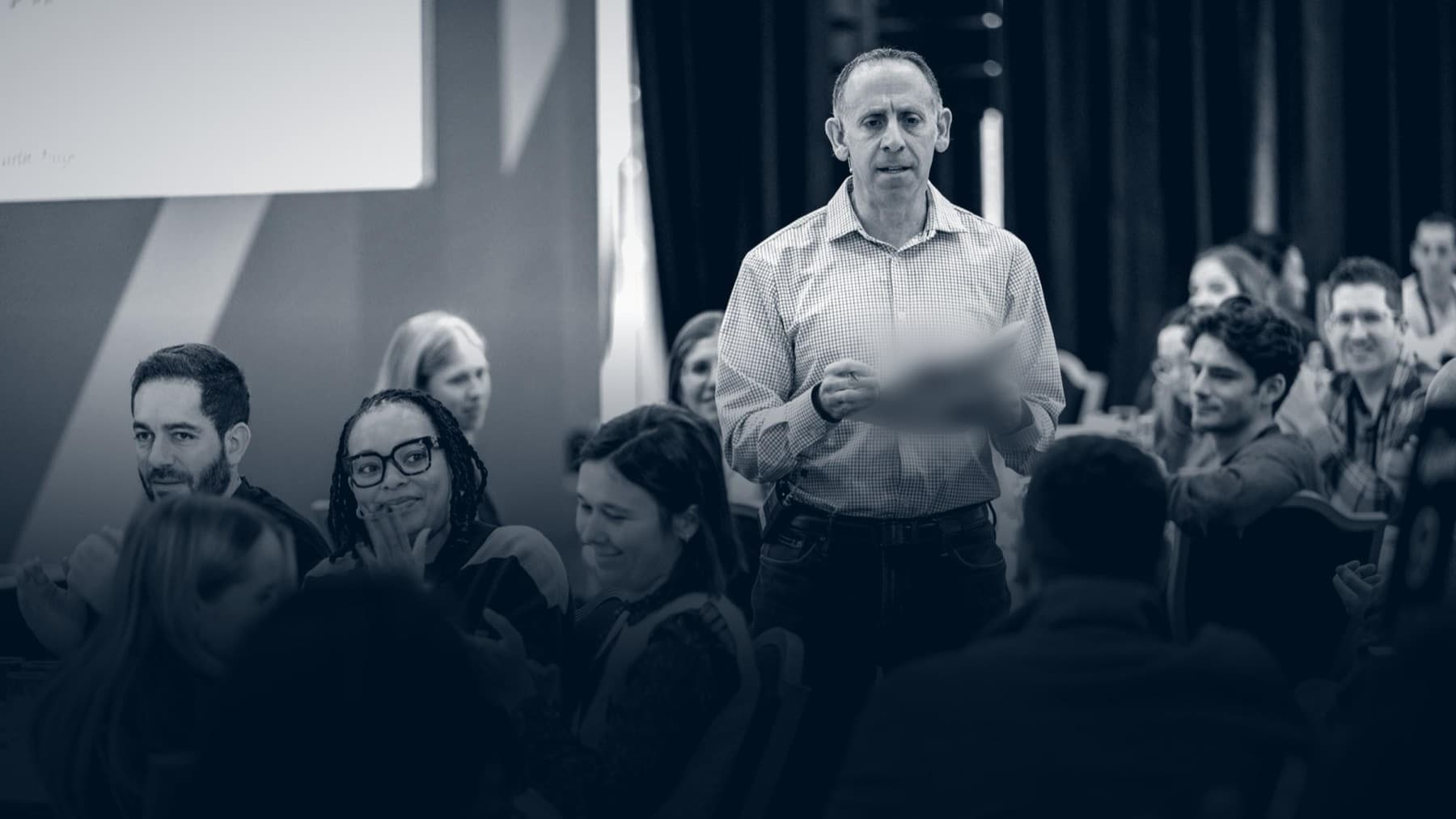
Two reasons this works
Coached Into the Behaviors That Underlie a High-Performing Culture
Training is where it starts; the behavior that holds after the event is what you are buying. So the work is repeated coaching on real, open opportunities, with the manager present, until people do the uncomfortable thing by default.
Why that mattersClose
Revenue: better discovery reaches business impact, which is where urgency and budget actually live. Cost: no repeat training spend two years later, because the behavior did not revert. Risk: behavior change is observable within weeks, so you can see whether the investment is working long before the revenue data arrives.
A seller has to recognize the deal on the slide
The content is rebuilt every time out of that company's own won and lost deals, which is why a rep in the room recognizes the deal being worked on the screen instead of watching a case study about somebody else.
Why that mattersClose
High Integrity Selling customized to your motion: separate openings by channel, your products inside the conversation rather than a placeholder, and a structure each person personalizes to their own style with the structural elements held fixed so a manager can still inspect it.
At Energage the method was built with separate openings for the recognition channel and the direct channel, and the methodology has traveled across roughly 35 to 40 companies through the Force Management channel. The content never traveled with it.
Revenue: a conversation built for your buyer converts, and a generic one gets recited at them. Cost: no second rollout to fit the method to how you actually sell.
Proof
Built for the Energage motion out of interviews with their own won and lost champions and with the reps who would be in the room, taught to the field in a single day on live opportunities, with the managers prepared beforehand to lead it rather than attend it. The behavior moved and it was documented while it was moving: sellers testing assumptions they had previously been inferring.
documented behavior change
What it is like to work with me

“I had the privilege to work with Russell 3 times. After many years of selling and sales leadership where I have been trained at Solution Selling twice, Customer Centric Selling 3 times, Sandler once, Force Management 3 times, I can easily say that Russell is one of the best facilitators of sales training I have met. His ability to lead a room with 2, 3 or 400 people is absolutely incredible. Russell has this gift of feeling the energy of the people he interacts with and can instantly adapt his speech to them; Russell has an extremely strong psychology and can really lead and inspire others through a shared objective. Last point that really inspired me when I was working with him is that Russell enjoyed so much what he does that it is contagious with everyone and make them enjoying learning.”

“Russell, I can’t begin to tell you how much I appreciate your efforts this week! I’ve been through many sales trainings and this was the best I’ve ever attended, much due to you. My team is pumped!”

“Russell, I teared up at the end of your session b/c you reminded me of why I loved sales strategy so much. Thank you for your warmth, the kindness you exuded, and the passion you shared.”

“I was not exaggerating when I told you, and several others, that I have been in many training classes over the years, and this will absolutely stand out as the best one, bar none.”

“Russell’s ability to break down complex concepts into simple, actionable strategies made an immediate impact. Since then, I’ve brought him back multiple times. Russell has a unique talent for making sophisticated sales principles easy to understand and, more importantly, easy to apply in day-to-day selling. Russell immediately elevates any GTM teams efforts.”
Questions people ask
We did sales training. It didn't stick. Why would this?
Because that is the normal outcome of training without reinforcement. And it is why your managers are in the coaching sessions from week one and why they get the inspection questions. Tell me what happened in the two quarters after: who reinforced it, and what did they inspect? The training is not the product. The habit is.
Do we need the messaging guide before we do the training?
No, and the order depends on which half you are missing. If your people know what to say and cannot run a conversation, start here. If they can run a conversation and every one of them says something different, start with the guide. Most companies need both and can only afford to notice one, which is why the discovery at the front of this engagement establishes which it is before anybody books a room. Where the message is the gap I will tell you, and I would rather move the training than teach a structure your team has nothing to put in it.
We already have a sales methodology. Do we have to replace it?
Usually not. Most of my work is making an existing one happen: content in the buyer's language, and manager reinforcement. Which one do you have, and what does a manager actually inspect in a pipeline review today? If your methodology is sound and unexecuted, that is the cheapest revenue available to you this year.
You're one person. Can you handle a company our size?
Tell me what scale means here: how many sellers, in how many groups, on what timeline. The constraint on this offer is days and cohorts rather than headcount. I have led rooms from fifteen people to five hundred, and I have facilitated across roughly 35 to 40 companies through the Force Management channel. What I do not do is staff junior consultants against your program. You get me, and a large rollout is a sequence of cohorts rather than a bigger team.
How do we know it will work?
Behavior is the thing to watch, and it is documented. Named sellers changed how they ran their calls inside a single coaching cycle, and I will walk you through what changed and how it was recorded.
Is the price justified for one person?
I am not the lowest-cost option and would not be credible claiming to be. Fixed bid, fixed scope, and one person accountable from the discovery interviews through the room and into what follows it: no translation loss across three vendors, no second discovery process, and an engagement designed to end rather than to renew. Look at it from the other side of the ledger too. Your whole field organization in a room for a day costs you more than I do, and the case for the day is that they walk out of it doing something differently.
This is the Energize part of the work: your leaders leading from the front and your team with a conversation it can actually run. Your goal; we get there together. It sits between Align, which is the story, and Sustain, which is the management system that keeps it.

Tell me how your top performer runs a first meeting, and how your median performer runs the same meeting.
That gap is where we would start.
Start a conversation